Performance Marketing Singapore: Complete Guide to Results-Driven Digital Advertising


Performance Marketing Singapore: Complete Guide to Results-Driven Digital Advertising
Performance marketing isn’t just about running ads.
Think of it like running a bubble tea stall. You don’t just put up a banner that says “Best Brown Sugar Boba in Town!” and hope customers come.
You track everything, how many people saw your ad on Instagram, how many searched your brand on Google, and how many actually placed an order on GrabFood or walked into your shop.
It's about knowing exactly what works, why it works, and how to scale it.
That’s the essence of performance marketing: clarity and control. You always know how much you spent, what results you got, and what to tweak next.
In this guide, we’ll unpack what performance marketing really means; how it works, why it matters, and how agencies like Omni Digital use data-driven creative systems to help brands scale profitably.
What is Performance Marketing?
Performance Marketing Definition and Core Principles
Performance marketing is a lead generation and conversion-driven approach to advertising, where every campaign is designed to capture intent-driven customers and turn them into buyers.
Its power lies in being measurable: because you can track every step of the customer journey, you can scale what works, cut what doesn’t, and grow profitably.
The ultimate goal isn’t just measurement — it’s sales impact. Measurement simply gives you the clarity to optimize smarter and scale faster.
The foundation of performance marketing lies in three core principles:
- Creative + Message Fit: Ads must grab attention and connect emotionally — not just look good.
- Audience + Platform Fit: Targeting the right people across Meta, Google, TikTok, YouTube, and LinkedIn.
- Continuous Optimization: Testing, measuring, and refining campaigns to reduce cost per lead and increase ROAS.
When these pillars work together, brands can predict outcomes, scale faster, and make every marketing dollar work harder, a necessity in Singapore’s cost-competitive market.
How Performance Marketing Works in Singapore’s Digital Landscape
Singapore’s digital scene is one of the most advanced in Southeast Asia, with over 90% internet penetration and consumers who spend an average of 2+ hours daily on social media.
Here’s how a performance-based campaign typically works here:
- Stage 1 – Awareness: Someone sees your TikTok or Facebook video ad.
- Stage 2 – Consideration: They later search on Google for reviews or visit your website.
- Stage 3 – Conversion: Retargeting ads or email automation nudges them to purchase or sign up.
Each step is measurable, giving brands real-time data to pause what’s underperforming and double down on what’s converting.
This cross-channel tracking makes performance marketing especially powerful for Singapore’s multi-device, always-online audience.
Performance Marketing vs Traditional Digital Marketing
Key Differences in Approach and Payment Models
Traditional digital marketing focuses on visibility and awareness; running campaigns to get your brand seen by as many people as possible. You pay for exposure, hoping that visibility eventually leads to sales.
Performance marketing, on the other hand, focuses on accountability and outcomes. It doesn’t just ask, “How many people saw the ad?” but rather, “How many people bought because of it?”
The key difference isn’t just in the payment model, but in the mindset:
- Traditional marketing = build recognition.
- Performance marketing = build measurable growth.
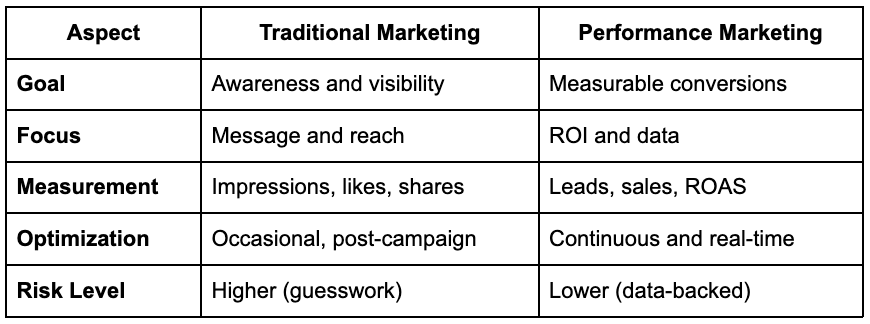
Traditional marketing might help you look famous; performance marketing helps you be profitable.
ROI Comparison: Traditional vs Performance Marketing
Let’s say a Singapore skincare brand spends $10,000 on ads.
With traditional marketing, that might get them 500,000 impressions, but no clear picture of how many led to sales.
With performance marketing, that same $10,000 can be tracked down to exact results:
- 20,000 clicks
- 2,000 leads
- 300 purchases
- 4.5x ROAS
That’s the power of measurable marketing. It’s not about spending more, it’s about spending smarter, understanding exactly where growth comes from, and replicating it.
Why Performance Marketing Matters for Singapore Businesses
Singapore’s Digital Market Is Getting More Competitive
Singapore is one of the most competitive digital markets in Asia. With over 90% internet penetration and a highly educated, tech-savvy population, businesses here fight for attention in every scroll and search result.
Running ads alone isn’t enough anymore, because everyone is running ads. The real difference lies in how intelligently campaigns are executed.
Many local businesses struggle because:
- They rely on “pretty” creatives without strategy.
- They target too broadly, wasting budget on the wrong audience.
- They don’t track or optimize their campaigns in real time.
Performance marketing solves these problems by combining creative, data, and continuous optimisation into a measurable growth system. This gives Singapore businesses a practical edge, especially in saturated sectors like tuition, home & living, beauty, and e-commerce.
Businesses Need Marketing That Proves Its Impact
In Singapore’s fast-paced digital environment, every business, especially SMEs and e-commerce brands, needs marketing that proves its impact.
Performance marketing is becoming the preferred model because it delivers three major advantages:
- Real-time tracking: Platforms like Meta Ads Manager, Google Ads, and TikTok Ads Manager show exactly what each campaign returns.
- Budget efficiency: Underperforming ads can be paused instantly, and profitable ones can be scaled quickly.
- Government support: Grants such as PSG and EDG make it easier for SMEs to adopt measurable marketing systems.
As a result, brands are shifting away from vanity metrics (likes, reach, followers) and focusing on bottom-line metrics like CPA (Cost per Acquisition) and ROAS (Return on Ad Spend).
Performance Marketing Keeps Costs Efficient for SMEs
Singapore SMEs operate in a high-cost environment. Performance marketing maximises efficiency because every dollar is tracked and accountable.
Businesses can:
- Lower CPL/CPA
- Allocate budget to high-performing channels
- Test new angles quickly
Paired with PSG/EDG support, performance marketing becomes an affordable and scalable system even for smaller brands.
Measurable Results Drive Predictable Growth
Singapore’s business ecosystem rewards data-driven decisions. Whether you’re a tuition centre measuring enrolments or an e-commerce brand tracking ROAS,
the question is always: What’s the return on our spend?
Performance marketing gives the answer. With tools like Meta Pixel, Google Analytics 4, and conversion APIs, brands can trace every click, lead, and sale back to the ad that caused it.
That clarity builds confidence. Business owners can finally see, not guess, which campaigns drive growth. And when marketing becomes measurable, scaling becomes repeatable.
For Singapore businesses that value predictability, performance marketing isn’t just another digital strategy, it’s the foundation for sustainable, profitable growth.
Top Performance Marketing Channels in Singapore
Search Engine Marketing (Google Ads Performance in Singapore)
Search Engine Marketing (SEM) remains one of the most effective performance channels in Singapore, especially for brands targeting ready-to-buy audiences.
When someone searches “vinyl flooring Singapore” or “math tuition near me,” they already have intent. Google Ads allows you to appear at that exact moment.
Key advantages include:
- High commercial intent: People searching are often ready to act.
- Clear tracking: Each click, call, or purchase can be measured.
- Smart bidding: Google’s AI adjusts bids automatically for maximum ROI.
Singapore’s cost-per-click (CPC) varies by industry. Education and home services average $1.50–$4.00 per click, while e-commerce ranges from $0.80–$1.50.
When managed strategically, SEM can deliver 3–6x returns, especially when paired with optimized landing pages and remarketing campaigns.
Social Media Advertising (Facebook, Instagram, LinkedIn, TikTok)
With over 5.5 million active social media users, Singapore’s social platforms are central to any performance strategy.
Meta (Facebook & Instagram):
Ideal for storytelling and retargeting. Singapore brands use Meta Ads to test multiple creatives and identify which hooks convert. It’s powerful for awareness-to-conversion funnels, especially for e-commerce and tuition centres.
LinkedIn:
B2B companies — from HR consultancies to training providers — rely on LinkedIn for qualified lead generation. The platform’s cost-per-lead may be higher, but the conversion rate and deal value often justify it.
TikTok:
Singapore’s fastest-growing ad platform, perfect for discovery and virality. With TikTok Shop integration, brands can now drive direct sales while tracking real-time ROAS.
The secret isn’t choosing one platform, it’s integrating multiple. Omni Digital often combines TikTok’s attention-grabbing videos with Meta’s retargeting ads and Google’s search intent, creating full-funnel synergy that compounds ROI.
Native Advertising and Content Marketing
Native ads blend seamlessly into the user experience, think sponsored articles or in-feed recommendations on platforms like Outbrain, Taboola, or MSN Singapore.
In Singapore, native ads are especially effective for education, finance, and wellness sectors, where audiences need more context before converting.
Paired with content marketing, blogs, guides, or advertorials — native ads can build trust and drive long-term traffic. The key is ensuring relevance and transparency: Singapore audiences value useful content over clickbait.
Affiliate Marketing Networks
Affiliate marketing lets brands tap into Singapore’s growing ecosystem of influencers, publishers, and comparison sites — and only pay when results occur.
Platforms like Involve Asia, Accesstrade, and Impact Radius allow local businesses to partner with affiliates who promote their products across blogs, YouTube, and review sites.
It’s especially popular in finance, e-commerce, and travel, where affiliates drive conversions through referral links. Performance metrics like CPA and conversion rate make affiliate campaigns easy to scale profitably.
Display and Programmatic Advertising
Display ads still play a key role in retargeting — reminding potential customers who’ve visited your site to return and purchase.
Through programmatic platforms like Google Display Network (GDN) or The Trade Desk, advertisers can automate bidding to reach users across thousands of sites in Singapore.
Programmatic campaigns shine when paired with first-party data (e.g. CRM lists), allowing hyper-targeted remarketing at scale.
Connected TV (CTV) and Video Marketing
Video consumption is booming in Singapore — with platforms like YouTube, Viu, and MeWatch attracting millions of viewers.
Connected TV ads merge storytelling with performance. Unlike traditional TV, you can track how many viewers watched, clicked, and converted after seeing your ad.
For e-commerce and D2C brands, short-form video ads on TikTok and YouTube Shorts perform exceptionally well. They combine reach with clear conversion data — proving that creativity and accountability can co-exist.
In summary, Singapore’s top-performing channels share one thing in common: trackability.
Whether you’re running SEM, Meta ads, or TikTok videos, the power of performance marketing lies in integration — where each channel supports the next, guiding customers from awareness to action.
How to Choose the Right Performance Marketing Agency in Singapore
What a Good Performance Marketing Agency Should Provide
A good performance marketing agency doesn’t just run ads, it builds a growth system.
In Singapore’s competitive landscape, this means combining creative strategy, paid media, and analytics to deliver measurable results.
Here’s what a capable agency should provide:
- Full-funnel strategy: From awareness to conversion, not just boosting posts.
- Creative production: Scroll-stopping videos, persuasive copy, and static creatives.
- Media buying expertise: Data-driven campaigns across Meta, Google, TikTok, and LinkedIn.
- Tracking & analytics: Clear dashboards showing ROAS, CPL, CPA, and conversions.
- Landing page optimisation: Making sure paid traffic actually converts on-s
At Omni Digital, for instance, every campaign is managed in a full circle; creative testing, performance tracking, and optimization — to continuously lower CPL and increase ROAS.
Questions to Ask When Choosing a Performance Marketing Agency
Before committing to an agency, ask practical, business-focused questions such as:
- What results have you achieved for similar industries?
- How do you measure success — leads, sales, or long-term growth?
- How often do you test creatives and audiences?
- Do I get ownership of my ad accounts and data?
- How will you communicate performance and next steps?
Good agencies welcome these questions because they rely on transparent systems — not guesswork.
Red Flags to Avoid When Selecting Agencies
Not all agencies in Singapore operate with accountability. Watch out for:
- Heavy focus on vanity metrics (likes, reach, engagement)
- Promises of “instant results” without proper testing
- Lack of transparency in ad spend and data ownership
- No structured reporting or optimisation process
- One-size-fits-all packages
If an agency cannot explain what worked, what didn’t, and how they’re improving next — that’s a major red flag.
In-House vs Agency: Which Is Better for Your Business?
Choosing between an in-house marketer and an agency depends on your resources and goals.
Both have pros and cons:
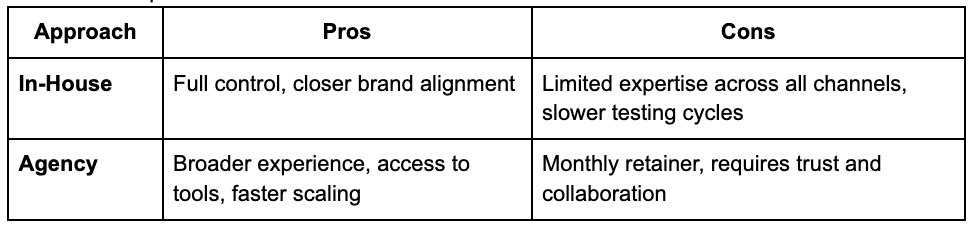
For most growing brands, partnering with an agency like Omni Digital offers the best of both worlds; expert strategy, creative production, and ongoing optimization without the overhead of building an internal team.
Best Performance Marketing Agencies and Companies in Singapore
Key Traits of High-Performing Agencies in Singapore
Not all agencies that “run ads” are true performance marketers. The best ones in Singapore combine creative excellence, technical expertise, and business acumen.
When evaluating agencies, look for those that:
- Have a proven system for testing and scaling campaigns.
- Offer transparent reporting, you can see exactly where your ad dollars go.
- Provide case studies with verifiable results (e.g. cost per lead, ROAS, sales growth).
- Specialize in your industry, whether it’s education, e-commerce, or services.
- Invest in continuous optimization, not just campaign setup.
The strongest agencies won’t just talk about “views” or “engagement”, they’ll show how their work translated into revenue and measurable growth.
Types of Performance Marketing Agencies (Specialist vs Full-Service)
Singapore’s agency landscape generally falls into two categories:
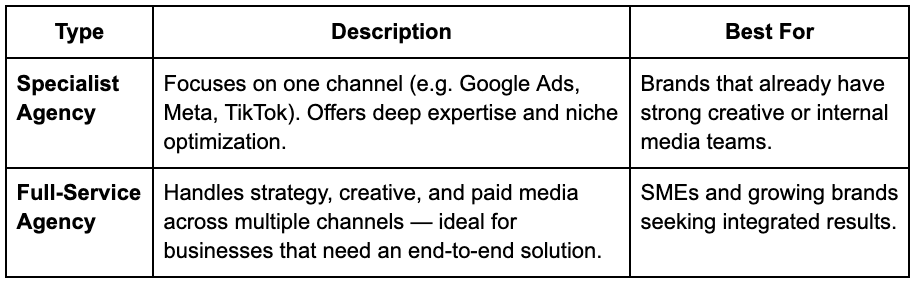
Agencies like Omni Digital fall into the full-service performance category, providing both creative production (video, static, copywriting) and paid ads management — all tied to ROI metrics.
How Top Agencies Prove Their Results and Track Record
Every credible performance marketing agency should be able to prove its impact.
Ask to see case studies showing metrics like:
- Lead volume and CPL improvement
- Revenue or sales growth
- ROAS achieved per channel
- Conversion rate uplift after creative optimization
For example, Omni Digital has helped:
- An e-commerce brand grow from $40K to $120K/month in 3 months.
- A tuition centre generate 170 leads in one month.
- A local home brand achieve 5–6x blended ROAS through creative testing and full-funnel optimization.
These tangible results demonstrate the hallmark of true performance marketing — scalable, measurable growth.
Budget Considerations When Working with Agencies
In Singapore, agency retainers typically range from $1,000 to $5,000+ per month, depending on service scope and ad spend.
While cheaper agencies may sound appealing, they often lack the data systems and creative testing process that drive consistent returns. Instead of choosing based on price alone, assess expected ROI.
A strong agency doesn’t cost — it pays. The right one can multiply your revenue by optimizing every dollar spent on ads.
Singapore Performance Marketing Regulations & Compliance
PDPA Compliance for Performance Marketing Campaigns
In Singapore, every performance marketing campaign must comply with the Personal Data Protection Act (PDPA). This law governs how businesses collect, use, and store customer data — especially from digital ads and lead forms.
Key requirements include:
- Consent: You must obtain explicit consent before collecting personal data (e.g. names, emails, phone numbers).
- Purpose Limitation: Data collected for marketing cannot be reused for unrelated activities without fresh consent.
- Access and Correction: Customers have the right to access and correct their data.
- Retention Limits: Personal data should only be stored as long as necessary.
For marketers, this means ensuring lead generation forms, CRMs, and email tools are PDPA-compliant.
Tools like HubSpot, Klaviyo, and Google Ads Lead Forms all have built-in consent checkboxes that align with Singapore’s data privacy laws.
Advertising Standards Authority Singapore (ASAS) Guidelines
The ASAS regulates advertising ethics through the Singapore Code of Advertising Practice (SCAP). It ensures that all digital ads — including performance campaigns — are truthful, transparent, and socially responsible.
Agencies and brands must avoid:
- Misleading claims (e.g. “100% guaranteed results” without proof).
- Bait advertising — showing fake discounts or limited-time offers that don’t exist.
- Unverified testimonials or paid reviews not disclosed as such.
Performance marketers in Singapore must balance strong direct-response messaging with ethical compliance — ensuring persuasive campaigns remain truthful and respectful.
GST Implications for Digital Advertising Spend
Since January 2023, Singapore’s GST applies to overseas digital services, including platforms like Google, Meta, and TikTok. Businesses registered for GST must account for output tax on their advertising spend or claim input tax credits accordingly.
For local SMEs, this means working with finance teams to ensure proper tax treatment of ad invoices, especially when working with global ad networks.
Cross-Border Data Transfer Considerations
Many performance marketing tools (like Meta Ads Manager or Google Analytics) process data on overseas servers. Under PDPA, businesses must ensure that any cross-border data transfers provide a comparable level of protection.
This includes using platforms with standard contractual clauses (SCCs) or privacy certifications such as ISO/IEC 27001.
Singapore brands that handle customer data across borders — especially in e-commerce or lead generation — should review their vendor privacy terms regularly to stay compliant.
Compliance isn’t just a legal formality — it’s part of trust-building. In Singapore’s tightly regulated and digitally mature market, brands that respect privacy and advertising integrity not only avoid penalties but also gain long-term customer confidence.
How to Measure Performance Marketing Success
Key Performance Indicators (KPIs) for the Singapore Market
Performance marketing is all about measurable outcomes, not assumptions. Tracking how effectively your campaigns convert attention into leads and paying customers.
The goal isn’t just to measure; it’s to use measurement to scale what drives sales and stop what doesn’t.
To know whether your campaigns are working, you must track the right KPIs, metrics that directly reflect growth and profitability.
Common KPIs include:
- CPA (Cost per Acquisition): How much you spend to get one paying customer.
- CPL (Cost per Lead): How much it costs to generate one qualified inquiry.
- ROAS (Return on Ad Spend): How much revenue you earn for every dollar spent.
- CTR (Click-Through Rate): How effectively your ad grabs attention.
- CVR (Conversion Rate): How well your website or landing page turns visitors into leads or customers.
Each KPI should align with your business goal — e.g. tuition centres focus on CPL and conversion rate, while e-commerce brands prioritize ROAS and AOV (Average Order Value).
Industry Benchmarks by Sector (E-commerce, B2B, Services)
Benchmarks in Singapore vary depending on the industry, ad platform, and product price point.
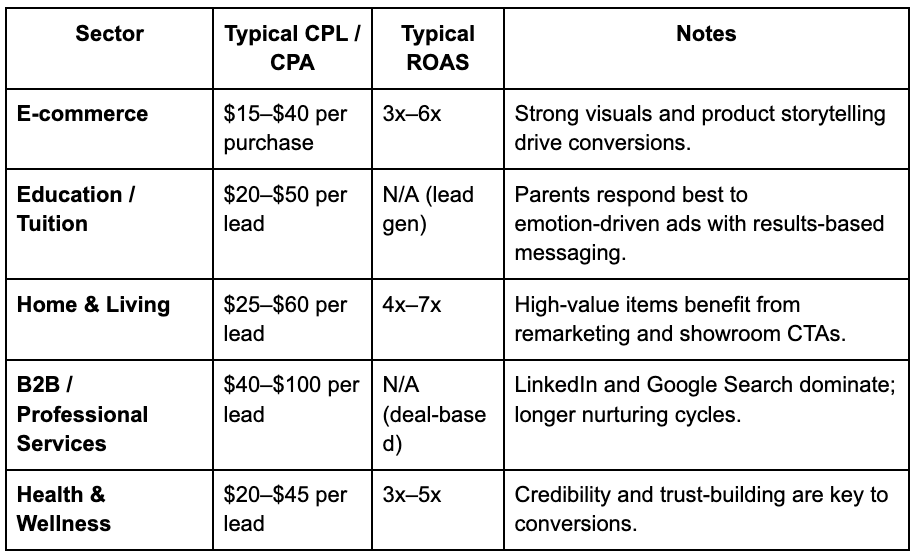
These are not fixed numbers but general ranges based on Omni Digital’s campaign data across Singapore clients.
Your exact metrics may differ depending on brand maturity, offer quality, and creative performance.
Cost per Acquisition (CPA) Benchmarks in SGD
In Singapore, CPA benchmarks typically range between $25 and $120, depending on complexity and competition.
Lower CPAs are achievable for high-volume e-commerce, while service industries (like interior design or education) may have higher acquisition costs but also higher revenue per sale.
The goal isn’t just lowering CPA — it’s optimizing for profitable CPA. A $70 CPA might sound high, but if it drives a $400 sale, it’s still an excellent return.
Return on Ad Spend (ROAS) Expectations
ROAS is the heartbeat of performance marketing.
- Healthy ROAS range in Singapore: 3x–6x for most e-commerce and service brands.
- Exceptional ROAS: 8x+ (often achieved after 2–3 rounds of creative and funnel optimization).
Agencies like Omni Digital continuously track and scale top-performing campaigns through its ROAS Maximizer System, refining ad creatives, messaging, and audience targeting weekly to maintain profitable growth.
When measured properly, ROAS and CPA turn into more than marketing numbers — they become indicators of business efficiency and long-term scalability.
Performance Marketing Tools & Platforms
Essential Analytics and Tracking Tools
Every successful performance marketing campaign starts with accurate tracking. Without it, you’re flying blind.
These are the must-have tools:
- Google Analytics 4 (GA4): Tracks website traffic, conversions, and customer journeys.
- Meta Pixel: Measures ad interactions across Facebook and Instagram.
- Google Tag Manager (GTM): Manages all tracking codes in one place.
- Hotjar / Microsoft Clarity: Visual heatmaps that show how users interact with your site.
- Looker Studio (formerly Data Studio): Converts complex data into clear, shareable dashboards.
These tools help business owners see not just how many people visit, but what actions they take — filling forms, adding to cart, or checking out.
Popular Advertising Platforms in Singapore
Singapore’s ad ecosystem is diverse, allowing brands to reach audiences across multiple touchpoints:
- Meta Ads (Facebook & Instagram): Dominates social performance marketing with strong visual storytelling and retargeting.
- Google Ads: Essential for search intent — especially effective for high-ticket services and retail.
TikTok Ads: Ideal for awareness and impulse conversions, with growing popularity among younger demographics. - LinkedIn Ads: B2B powerhouse, effective for generating qualified leads among professionals.
- YouTube Ads: Perfect for long-form storytelling, education, and product demonstrations.
Most Singapore brands thrive by combining at least two complementary platforms — e.g. TikTok for discovery and Google for intent.
Attribution and Conversion Tracking Solutions
Performance marketing succeeds when you know which touchpoints actually drive conversions.
Tools like Triple Whale, Northbeam, or Hyros provide deeper attribution insights across Meta, Google, and TikTok. For SMEs, affordable alternatives like Shopify Reports or Google Analytics 4 attribution modeling can also reveal the buyer journey.
Omni Digital integrates these insights through custom dashboards that show exactly which ad, audience, and creative drove the final sale — eliminating guesswork and enabling smarter scaling decisions.
Budget Management and Optimization Tools
Managing ad budgets manually can be time-consuming. Automation tools streamline this process:
- Revealbot / Madgicx: Automate bid adjustments and creative testing on Meta and Google.
- AdEspresso: Simplifies multi-ad testing for SMEs.
- Supermetrics: Pulls data from multiple ad accounts for easy budget tracking.
These tools allow Singapore marketers to optimize in real-time, ensuring budget shifts toward the highest-performing ads.
Ultimately, tools don’t replace strategy, they amplify it. The best Singapore performance marketing campaigns use automation and analytics together, with human insight guiding every decision.
Performance Marketing Tips & Pitfalls for Singapore SMEs
Performance marketing can deliver strong, predictable results for SMEs — but only if it’s done with the right structure and mindset.
Below is a simple, practical guide on what works and what to avoid, written specifically for Singapore SMEs.
1. Spend Smart, Not Big
Start with a manageable budget (e.g., $1k–$3k/month) to collect meaningful data. Small, consistent spending beats spreading money across too many channels.
Avoid: Throwing small amounts everywhere or scaling too quickly. Overspending before you have proven results usually leads to higher costs and inconsistent performance.
2. Target the Local Market Properly
Use Singapore-specific audiences, keywords, and relatable examples. Ads that feel familiar — the tone, phrasing, and scenarios — perform far better here.
Avoid: Generic or overseas-style messaging. Singaporeans can instantly tell when an ad “doesn’t feel local,” and that usually kills conversions.
3. Use Multiple Channels Together
Most successful SMEs combine at least two major channels (Meta + Google, or Meta + TikTok). This supports the full buyer journey — from discovery to search to conversion.
Avoid: Relying on only one platform or chasing trends without strategy. Over-dependence on one channel means risk spikes if performance drops.
4. Let Data Guide Every Step
Install proper tracking tools such as Meta Pixel, Google Analytics 4, and UTM parameters. With clean data, you can see exactly which ads, audiences, or platforms are driving results — and make decisions confidently.
Avoid: Running ads without tracking or checking only surface metrics like impressions. Without proper data, every decision becomes guesswork, and budgets get wasted fast.
5. Build Simple, Clear, Relatable Creatives
Creatives don’t need to be fancy — they need to be understood. For Singapore audiences, straightforward messages, clear benefits, and simple visuals tend to outperform overly dramatic or complicated ads.
Avoid: Over-designed creatives that look good but convey nothing. Singaporeans value clarity over flashiness, especially when making buying decisions.
6. Optimise Consistently, Not Occasionally
Check your campaigns weekly. Pause poor performers, test new angles, refresh creatives, and scale winners slowly (10–20% increases). Consistent refinement keeps CPAs stable and ROAS improving.
Avoid: “Set and forget” campaigns. Even strong ads eventually fatigue. Leaving campaigns untouched for weeks is one of the biggest causes of rising costs.
7. Follow Local Advertising Rules
Ad standards in Singapore are strict. Make sure your campaigns follow PDPA and ASAS guidelines, especially when using testimonials, medical claims, financial benefits, or data collection forms.
Avoid: Overpromising (“guaranteed results”), misleading claims, or collecting data without consent. These can lead to takedowns or penalties — and damaged brand trust.
In One Simple Summary
- Singapore SMEs succeed with performance marketing when they:
- Spend smart
- Target locally
- Use a mix of channels
- Let data lead
- Keep creatives clear
- Optimise consistently
- Stay compliant
Avoiding the common mistakes — broad targeting, poor tracking, overpromising, and “set and forget” campaigns — helps SMEs stretch their budget further and grow steadily.
Getting Started: Your Performance Marketing Roadmap
Step 1: Setting Clear Objectives and KPIs
Before launching ads, define what success looks like. Do you want leads, sales, or brand recall? Your goals determine your metrics.
For example:
- Tuition centres focus on CPL (Cost per Lead).
- E-commerce brands track ROAS (Return on Ad Spend).
- B2B firms prioritize qualified inquiries or booked calls.
Setting clear KPIs keeps both marketing teams and agencies accountable — ensuring every dollar is tied to measurable progress.
Step 2: Budget Planning and Channel Selection
In Singapore, most SMEs start effectively with a $1,000–$3,000/month ad budget.
Choose platforms based on audience behavior:
- Meta (Facebook & Instagram): For broad awareness and storytelling.
- Google Ads: For search intent and purchase-ready users.
- TikTok: For brand discovery and creative engagement.
Start with one or two key platforms. Spreading too thin too early dilutes results. Always reserve 20–30% of your budget for testing new creatives or audiences.
Step 3: Campaign Setup and Launch
Build campaigns around a strong offer and clear message. Ensure:
- Tracking tools (Meta Pixel, GA4) are properly installed.
- Ad creatives and headlines are tested across variations.
- Landing pages are optimized for mobile — crucial in Singapore, where over 80% of ad traffic comes from smartphones.
Soft-launch campaigns for 3–5 days to collect data before scaling spend.
Step 4: Monitoring, Optimization, and Scaling
Performance marketing is not “set and forget.” The best results come from daily monitoring and weekly optimization.
- Pause low-performing ads quickly.
- Duplicate and scale winners by 10–20% increments.
- Refresh creatives every 2–4 weeks to avoid ad fatigue.
Use data dashboards (like Google Looker Studio) to track key metrics across all channels.
When your campaigns consistently hit target ROAS or CPL, it’s time to scale — confidently and profitably.
Ready to Scale with Omni Digital?
Most businesses in Singapore don’t fail because their products are bad — they fail because their marketing doesn’t convert.
If you’re tired of guessing what works and want a clear, proven way to turn ad spend into sales, Omni Digital can help.
At Omni Digital, we don’t just run ads. We build conversion systems that connect creative, media buying, and analytics, helping brands scale from stuck in 5 figures to 7-8 figures of monthly revenue in less than 5 months while keeping every dollar accountable.
Whether you’re an e-commerce brand, tuition centre, or home & living business, our ROAS Maximizer System is built to help you:
✅ Lower cost per lead and boost ROI
✅ Find your most profitable audiences
✅ Turn ad views into repeat customers
If you want to see what performance marketing done right looks like — and how it can scale your business predictably — let’s talk.
👉 Book a free strategy call with Omni Digital today to discover how to grow smarter, faster, and profitably.